
Portage Projected and Actual Release
A projected date is calculated from the sentence and information known at that point. An actual release date records when custody ended. Between those events, jail-time credit, earned credit, discipline, a new court order, a detainer, parole action, or a correction to the sentence can alter the plan. An Ohio state-prison detail may also combine a possible exit date with parole eligibility, so the date must be read with its exact label.
Scheduled versus actual: “Expected Release Date/Parole Eligibility Date” may be a calculation or the point when parole can be considered. It is not proof that the person left custody.
Pretrial custody is different. A person awaiting trial at the Portage County Jail has no sentence term to calculate. Bond may be posted, a judge may order release, or another hold may keep the person in custody. The court journal supplies legal authority, while the jail movement entry supplies the physical time and destination. A transfer to ODRC, another county, the U.S. Marshals Service, treatment, or a hospital is not the same as community release.
A sentenced county-jail term also differs from a state-prison term. Portage court entries identify the imposed jail term and jail-time credit. PCSO records document the eventual release or transfer. ODRC's projected fields become relevant only after a person enters Ohio state prison custody.
Find a Portage Projected Release
Start by classifying custody. The Portage eServices court search covers county criminal dockets. The ODRC Offender Search covers Ohio prison, APA supervision, and judicial-release records within its stated scope. Neither is a complete substitute for the other. A Portage County conviction can send someone to a prison elsewhere in Ohio, and “Portage” in ODRC may mean county of commitment rather than physical location.
- Identify whether the person is pretrial, serving a Portage county-jail term, or serving an Ohio prison term. Read the latest docket entry rather than relying on where the arrest began.
- For state prison, search ODRC by offender number or name. Match date of birth, Portage commitment county, docket, offense, and sentence.
- Read the entire sentence block. Record the exact “Expected Release Date/Parole Eligibility Date,” POA/PRD date, next hearing month, and latest Board result when shown.
- For a county-jail sentence, obtain the sentencing entry, the court's jail-time credit finding, and the PCSO release or movement record. No current Portage county good-time rule was verified.
- Confirm the final event with the custodian. A future calculation or court order alone does not prove the jail or prison finished processing release.
The broader Portage County released-inmate lookup explains how court, jail, state, and federal records separate release from transfer. For this date question, preserve each source label. Do not convert a parole-eligibility date into an exit appointment or a court order into a physical timestamp.
Note: Name alone is weak identity evidence; use an offender number, birth date, docket, offense, and commitment county when possible.
Portage ODRC Release Date Fields
ODRC uses a combined label: Expected Release Date/Parole Eligibility Date. Its definitions describe this as the projected release date or the date pending parole consideration. The same detail can show POA/PRD Date. POA means “parole on or after,” while PRD means “Projected Release Date.” Those abbreviations look concise, but they can represent different legal paths.
| ODRC field | How to read it |
|---|---|
| Expected Release Date/Parole Eligibility Date | A calculated date or a point for parole consideration, depending on sentence type. |
| POA/PRD Date | Parole on or after, or projected release date. Read the surrounding release detail. |
| Next Board Hearing/Review Month | The scheduled review month, not a release grant. |
| Latest Hearing Type and Result | The most recent Board action, which may grant, deny, defer, continue, or address another review. |
| Jail-Time Credit | The credited confinement recorded in the sentence detail; confirm it against the court entry. |
| Status and Release Detail | Whether the person is incarcerated, released, under APA supervision, or in another displayed category. |
For a definite sentence, the date may function as an expected exit after the current calculation. For an indeterminate or life sentence, it may be the point at which the Parole Board can consider release. The next review and latest result are essential in that second setting. A grant may still include conditions and a later projected date. A denial generally produces a continued hearing rather than release.
The official ODRC definitions are shown in the matched manifest image.
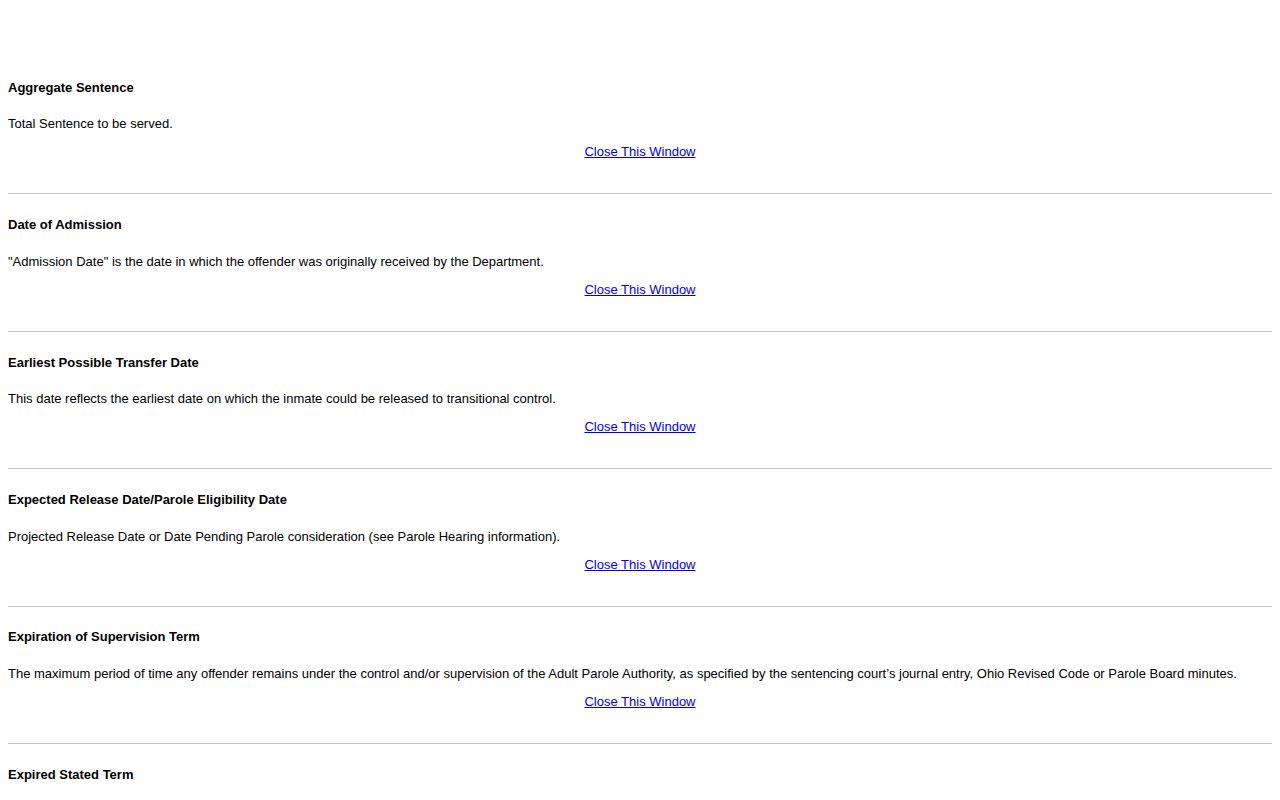
The image connects the combined field name to the official definitions that should control any Portage release-date reading.
Portage Release Credit Rules
Ohio jail-time credit and earned credit are separate. ORC 2967.191 applies qualifying confinement credit against relevant prison or jail terms. Under the sentencing framework, the court determines the credit figure. That number should come from the Portage sentencing entry and the ODRC detail, not from a new calculation based only on arrest and sentencing dates.
Earned credit depends on sentence type, offense date, eligibility, exclusions, and qualifying activity. Current ORC 2967.193 and ORC 2967.271 address parts of that framework. Credits can have different caps. Mandatory terms and some offense categories are excluded. Credits may be denied or withdrawn under the applicable rules. A clean percentage cannot capture those differences.
No universal 85% rule: Some eligible terms may approach an 85% floor under a 15% cap, but Ohio does not require every prisoner to serve exactly that share.
Reagan Tokes non-life indefinite terms have a minimum term, a presumptive earned early-release point, and an imposed maximum. Statutory process may allow continued confinement after the minimum. Old-law and life sentences use parole-eligibility rules, chiefly ORC 2967.13. Some life minimums cannot be reduced by earned credit. Correct reading starts with the sentence itself, not a slogan.
Note: Apply the statute and rule version tied to the offense and sentence date because Ohio credit law can change.
Why Portage Release Dates Change
A projected release date can move for reasons that originate in prison administration, another agency, or a court. The change may shorten the estimate, extend it, or turn a planned community release into a transfer. The responsible record should show the event. Avoid guessing from a date that disappeared or shifted in an online result.
| Factor | Possible effect | Best source |
|---|---|---|
| Jail-time credit correction | Changes credit against the imposed term | Portage sentencing entry and ODRC detail |
| Earned credit gained or withdrawn | Moves an eligible calculated date | Current ODRC record and governing rule |
| Concurrent or consecutive terms | Changes how multiple terms combine | Sentencing journal and sentence block |
| Detainer or new case | May cause transfer or continued custody | Custodian movement record and new docket |
| Judicial release | May authorize earlier release to supervision | Portage court order and ODRC detail |
| Parole Board action | May grant, deny, defer, or set later review | Board result and ODRC date fields |
A detainer is a request or notice from another authority concerning custody. It can mean the person leaves one facility but enters another agency's control. A movement out of the Portage County Jail under a DRC, federal, or other-county hold is therefore not proof of community release. Follow the receiving agency identified in the movement record.
Court orders and jail processing also create distinct timestamps. A judge may issue an order before the facility verifies identity, checks other holds, and completes release documents. When the physical time matters, ask for the jail movement entry rather than treating the order time as the door-out time.
Portage County Jail Release Dates
A Portage county-jail sentence begins with the court's imposed term and credited days. Municipal Court handles misdemeanors and preliminary felony proceedings. Common Pleas General handles indicted felony cases. Read the correct docket for the sentence, commitment, credit, later modification, and any conveyance. A person awaiting trial has no sentence-based release calculation, while a person serving a fixed local term can have an expected completion date subject to other orders or holds.
No current official Portage County good-time policy or weekend-release rule was located in the research sweep. Do not borrow a policy from another Ohio jail. Contact the PCSO Records Division for the existing movement or release entry. Records questions go to 330-297-3892 during Monday through Friday office hours. The Justice Center's main number is 330-296-5100 option 9.
Ask for the release date and time, release authority or code, and destination or receiving agency if a transfer occurred. If the sheriff uses an abbreviation, request its code legend. The court shows why the release was lawful. PCSO shows when county custody changed. Both are needed when the two timestamps differ.
Confirm Portage Projected Release Changes
For an Ohio state prisoner, return to the live ODRC detail near the expected date. Check status, release detail, APA supervision, and any changed hearing information. For a Portage jail term, check the court journal and obtain the PCSO release entry. If the record says transfer, follow the named agency. A person may leave county custody for state or federal custody without entering the community.
Ohio VINE can send a prospective custody-change alert for participating county jails and ODRC. It distinguishes general release from events such as transfer. Registration and PIN steps are covered on the Portage County VINELink inmate search. Treat the alert as a prompt to verify, not as a durable release instrument. The jail, ODRC, and court remain the stronger sources for the final record.
If a future date passes with no release, do not assume an error. Compare sentence type, current ODRC status, Board action, detainers, and new docket entries. A projected date may have been eligibility, may have changed through credit or discipline, or may have led to another form of custody. Recording the exact field and the date checked makes later changes easier to explain.
Note: A general-release alert and a transfer alert have different meanings, even when both report that one facility's custody ended.