
Portage Parole and Probation Compared
Parole, post-release control, judicial release, and county probation can all place a person in the community, but they arise from different legal acts. Ohio parole is a discretionary prison release used mainly for eligible old-law or life sentences. Post-release control follows certain modern prison terms. Judicial release occurs when the sentencing court releases a person from prison under ORC 2929.20. Portage County probation, commonly called community control in Ohio court records, is imposed and monitored through the county court system rather than through the state parole agency.
The agency matters because no single search covers every form of supervision. The Ohio Department of Rehabilitation and Correction Offender Search covers people in Ohio prisons, under Adult Parole Authority supervision, or judicially released within the tool's stated scope. A Portage court docket is the better source for local probation. The Portage County released-inmate search helps distinguish a jail exit from a later state-prison release.
| Supervision type | Who orders it | Where to verify |
|---|---|---|
| Parole | Ohio Parole Board in an eligible case | ODRC detail and Board result |
| Post-release control | Required by the sentence and Ohio law | ODRC detail and assigned APA office |
| Judicial release | Sentencing court | Portage docket plus ODRC detail |
| Probation or community control | Portage County court | Sentencing docket and Adult Probation |
- Parole
- Conditional release from prison after a discretionary state decision in an eligible case.
- Probation
- Court-ordered supervision in the community, called community control in many Ohio records.
- Discharge
- The formal end of a supervision term, not merely release from a jail or prison.
- Absconder
- A person alleged to have stopped reporting or left supervision without authority.
Verify Portage Post-Release Supervision
Begin with identity, not a status label. A shared name can lead to the wrong record. Match date of birth, offender number, Portage as county of commitment, docket number, and offense whenever those fields are available. ODRC advises that fewer search terms can produce better results, so a last name or offender number is often the best first query. Run separate searches for Released and APA Supervision. A person outside prison may be under APA control even when a Released-only query does not place the record where expected.
- Open the official ODRC search and enter the offender number, including an A, R, or W prefix when known. Otherwise, start with the last name.
- Select APA Supervision. Open likely matches and compare stable identifiers, the Portage docket, county of commitment, and offense.
- Read the supervision start, expiration or term, release detail, and assigned APA office. Use the office on the live record rather than assuming all Portage cases go to one Akron unit.
- If ODRC has no matching supervision record, search the Portage eServices court docket for the sentencing order, community-control terms, and later termination entry.
- Contact Portage County Adult Probation for a county community-control case. Contact the displayed APA office for state parole or post-release control.
A court sentence proves the legal order. It may not show each later office assignment. In the other direction, APA Supervision strongly indicates that someone is outside an Ohio prison under state control, but it does not prove when that person physically left the Portage County Jail. Exact jail movement still belongs to the Portage County Sheriff's Office release record.
Note: A Portage commitment county is not the same as a current prison, home address, or assigned supervision office.
Portage County Probation Office
Portage County Adult Probation handles community control ordered through the county court. It is separate from the Ohio Adult Parole Authority, which is part of ODRC's Division of Parole and Community Services under ORC 5149.03. A person whose record says parole, post-release control, or APA Supervision should not be routed to county probation solely because the conviction began in Portage County. The live ODRC detail should identify the state unit responsible for that case.
Portage County Adult Probation
209 S. Chestnut St., Suite 302
Ravenna, OH 44266
Phone: 330-297-3650
Hours: Monday through Friday, 8 a.m. to 4 p.m.
Before calling, note the court level and case number. Municipal Court handles misdemeanors and preliminary felony matters, while indicted felony cases move through Common Pleas General. A sentencing order often identifies community-control terms. Later journal entries may show a violation, modification, transfer, termination, or discharge. Office staff can then match the question to the case without treating a state APA matter as county probation.
The Ohio Adult Parole Authority page describes state field supervision and related functions. The matching manifest image shows the official APA starting point rather than a county probation screen.
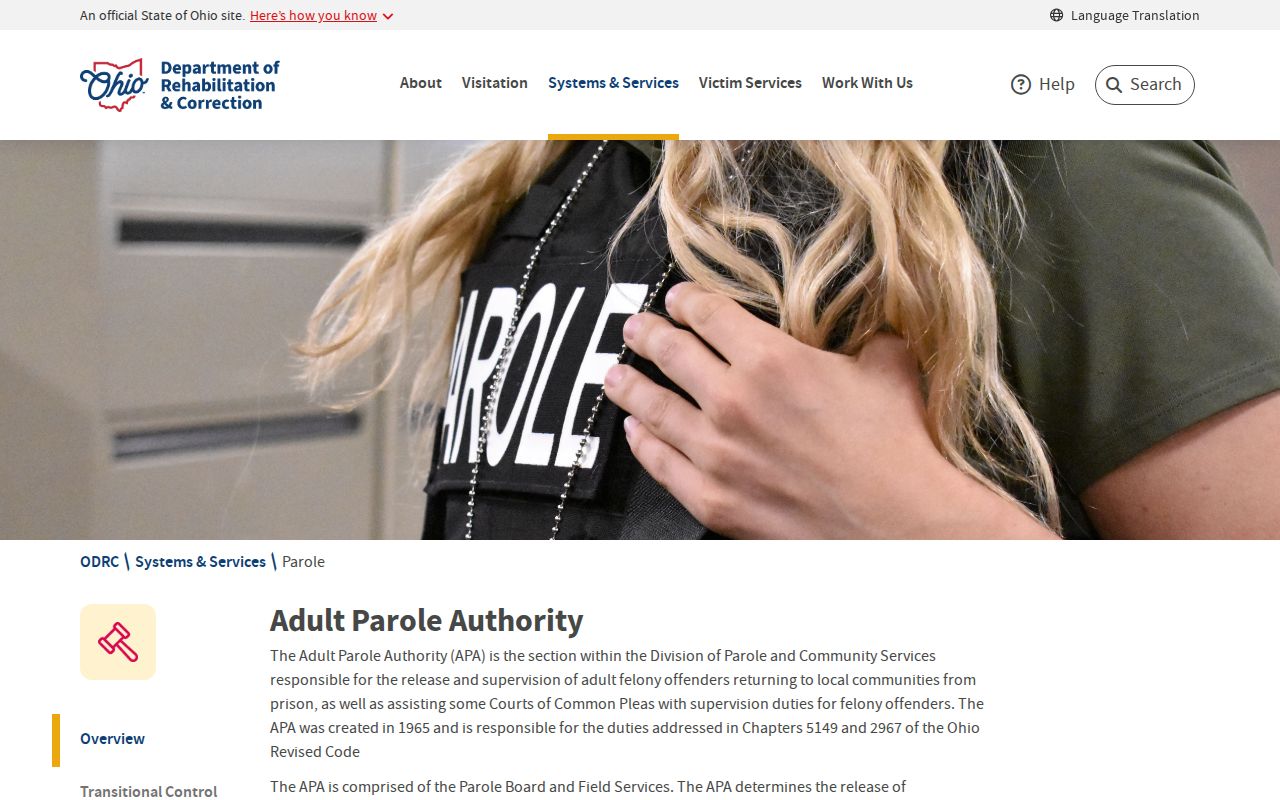
The displayed state resource is useful after the ODRC detail confirms APA supervision and identifies the correct field office.
Property After Portage County Release
Kent Police publishes unusually specific information about property at its separate city jail. Jewelry, a wallet, hat, phone, and other items are inventoried during booking and returned at release. That local statement applies to Kent custody. It should not be treated as a Portage County Justice Center policy. Ohio's jail rule does require a receipt for property returned on release or transfer, but each custodian keeps its own record.
Property return can help identify which agency completed the physical release. It does not establish parole or probation status. A person may receive property after a short Kent jail stay and still face county community control ordered by a court. Someone transferred from the Justice Center to ODRC may have a transfer record rather than a community-release entry. Ask the agency that held the person for its own property receipt when that point matters.
The Kent Police jail description is the source for the Kent-specific list. State supervision must still be checked through ODRC, and county probation remains tied to the Portage sentencing docket.
Note: A property receipt marks an agency handoff or release step, but it does not identify the later supervision type.
Portage Parole Violators at Large
ODRC provides a public state path for alleged parole and post-release-control absconders. In Offender Search, choose Violators at Large, then open a possible match and verify the same stable identifiers used for any supervision record. The label means an obligation remains unresolved. It must not be described as a normal, completed release from supervision. ODRC also warns that a displayed address is only the last recorded address and may not be current.
Important: Do not approach or try to apprehend a person shown as a Violator at Large. Law enforcement must confirm a warrant through official systems.
The PCSO Civil Division and Warrants page explains the local warrant function, but the research sweep found no public searchable Portage County warrant list. A missing web result never proves that no warrant exists. Likewise, a VAL address is not a safe way to locate someone. Record the ODRC status and ask the proper agency to verify it.
County probation violations follow the sentencing court and Portage probation process, not the ODRC VAL filter. Search the court docket for violation filings, warrants, hearing entries, changes to community control, or a termination order. The distinction prevents a county court matter from being mislabeled as state parole.
Portage Supervision Terms and Violations
Conditions vary by sentence and supervision type. Common records may refer to reporting, approved residence, travel limits, treatment, program participation, or compliance with other court orders. The actual order controls. A public ODRC summary or Portage docket may show the broad type and term, but it may not expose every case-management detail. Do not infer a violation from a missed call, an old address, or an online status that has not yet refreshed.
Parole Board decisions, APA field supervision, and county court enforcement serve different roles. The Ohio Parole Board decides eligible discretionary-release matters. APA supervises state cases in the community. Portage courts impose and modify county community control. A court can also grant judicial release from an Ohio prison, after which both the docket and ODRC detail may be needed to understand the resulting control.
VINELink is designed for custody events and alerts. It is not the primary tool for proving each probation condition or a final discharge. For a current state supervision label, use ODRC. For local probation, use the court journal and Adult Probation. When a record mentions a hold or warrant, the responsible agency must confirm what remains active.
Note: Online supervision summaries can lag, so the current court entry or assigned agency should resolve a material conflict.
Portage Parole and Probation Discharge
Release from a jail or prison and discharge from supervision are separate events. A person may leave an Ohio prison under parole or post-release control and remain under APA authority for a stated term. The ODRC detail may show a supervision start, expiration, release type, and office. A later status change can mark the end of that state control. For county probation, look for a Portage court journal entry that terminates or discharges community control.
Use the legal source that created the supervision. ODRC and APA records control state cases. The Portage sentencing docket and Adult Probation control county community control. A VINE alert about release from custody is not proof that supervision has ended. Neither is disappearance from a current jail view. If the sources differ, compare their event dates and labels before drawing a conclusion.
A complete verification records the person's identifiers, the original Portage docket, the custody-release event, the supervision type, and the discharge entry if one exists. This chain separates physical release, active supervision, an alleged violation, and final discharge. Those four points can occur months or years apart, and each may be held by a different office.