
Portage County 72 Hour Feed
PCSO did not publish a distinct rolling 72-hour release view when checked July 31, 2026. Reviews of the current sheriff site, the county-hosted PCSO page, and the Corrections section found no official adult inmate search or recent-release archive. As a result, there is no supported online three-day window, update cadence, field set, retention term, or booking-photo display to describe. A date-bounded public-record request is the closest official substitute.
The three-day purpose differs from a same-day alert. It is a short reconciliation period. Court actions from Friday through Sunday may span different docket entries, while the records office follows weekday administrative hours. A person sentenced on a felony matter may also begin to appear in ODRC after leaving the county jail. That is a state-prison transfer, not release to the community.
Check Portage Three-Day Releases
Start by fixing an exact beginning and ending time. That makes the request more useful than asking for a general list of everyone who left recently. It also helps PCSO distinguish the records that already exist from a new analysis the office is not required to create. Include transfers at first, then ask for the code legend so community exits can be separated from agency handoffs.
- Set the start and end timestamps for the full 72-hour period, including the correct local date and time.
- Search the official Portage court portal in both Municipal and Common Pleas when the case may have moved after indictment.
- Ask PCSO Records for people whose physical custody ended in the range, including the release type, authority, and destination fields already kept.
- Request the release-code legend. Do not guess whether an abbreviation means bond, recognizance, time served, state prison, or transfer.
- Review an Ohio VINE event for the named person and agency. Treat a general release differently from a transfer, then verify the notice with its source.
- Run ODRC Released and APA Supervision searches for a state release, but use Incarcerated when a felony conveyance from Portage is possible.
- Follow any receiving agency named in the county record before describing the person as released into the community.
Identity matching is essential across several records. Use a date of birth, jail or offender number, docket, offense, or county of commitment along with the name. Court entries can explain authority, but no guaranteed update cadence was found for the clerk portal. The PCSO movement entry remains the best local evidence of the physical change in custody.
Note: Use the Jail Releases: 24 Hours process when the need is same-day confirmation rather than three-day reconciliation.
Portage 72 Hour Record Fields
No public Portage County 72 hour release list supplies a visible set of columns. A request should instead name the existing county-jail fields needed to classify every movement in the selected range. Ohio's jail standard supports asking for the release or transfer entry, including the receiving agency when custody passes to someone else.
| Field | Three-day use |
|---|---|
| Name and jail identifier | Links each movement to a specific booking episode. |
| Booking or commitment time | Separates two custody episodes involving the same person. |
| Release date and time | Places the custody change inside or outside the requested range. |
| Release type and code legend | Explains the agency's exact label without unsupported expansion. |
| Authority and related case | Connects the physical movement to a court or other directive. |
| Receiving officer or agency | Shows that a listed departure was a transfer rather than freedom. |
| Destination | Directs the next check to ODRC, USMS, another county, or another named custodian. |
A release record answers who moved, when custody changed, by whose authority, and to whom or where. “Bond posted” means release pending the case, not dismissal. “Time served” may end the jail term while another case or supervision continues. “Sentence complete” may still be followed by a detainer. A deceased-custody closure is never a community release. Keep the office's label intact when the meaning is uncertain.
Portage Weekend Release Reconciliation
A 72-hour span often covers hours when administrative offices are closed. PCSO lists Records hours as Monday through Friday, 8 a.m. to 4 p.m., while the jail itself operates continuously. Bonds add another local timing detail. PCSO says courthouse bonds are accepted on weekdays from 8 a.m. to 4 p.m., and Municipal Court bonds can be paid at the jail after 5 p.m. on weekdays or at any time Saturday and Sunday.
Those facts make a three-day review useful, but they do not establish a set release schedule. Bond payment can precede the actual exit because staff may need to check identity, other holds, and release documents. Holidays can also affect when an office responds. Ohio public-record law requires prompt inspection and copies within a reasonable period, not a fixed number of hours or days.
Do not force court, jail, and notification times to match. An order time, payment time, physical release time, and VINE notice time represent different events. List each one with its source. If a conflict remains, seek the jail's audit or movement entry instead of choosing the latest timestamp by default.
Request Portage 72 Hour Records
The PCSO Records Division accepts focused requests and provides 330-297-3892 for questions. A useful range request asks for “persons whose physical custody at Portage County Jail ended between [timestamps], including release to community and transfer, with release type and destination fields.” If community releases alone are needed, ask whether an existing code permits the office to separate them. Do not ask staff to create a new conclusion about who was “really released.”
Ask for electronic copies when available. If staff requests clarification, narrow the range, location, and record categories. If the request is denied in full, seek redacted nonexempt portions and the specific legal authority. Fees and timing depend on scope, storage, review, redaction, and office policy. No sheriff fee should be borrowed from the commissioners' separate schedule.
The official request channel is shown in the manifest image below. Visit the source page for PCSO release records before relying on the screenshot.
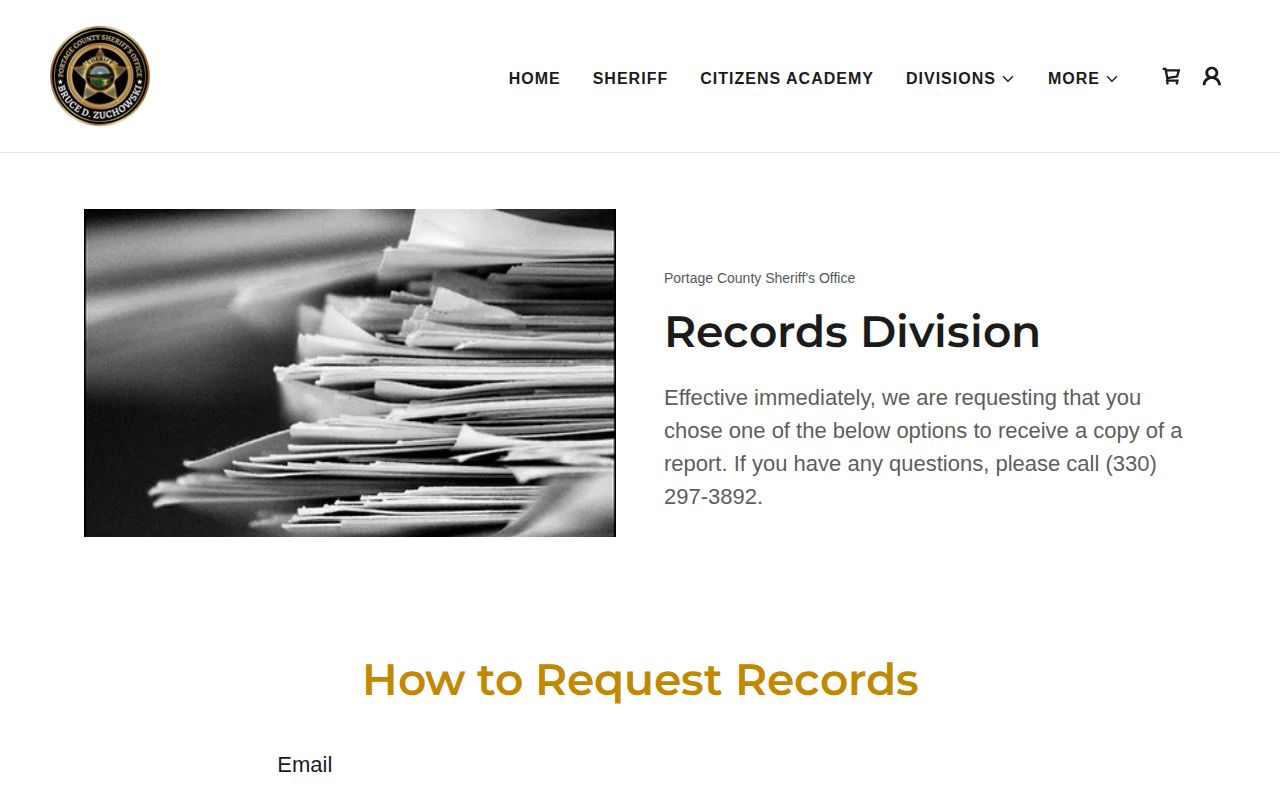
This route provides a lawful, date-bounded alternative to a public three-day feed that PCSO did not publish when checked.
Missing Portage Release Names
Portage County's defining data issue is the lack of both an official roster and distinct 24-hour or 72-hour released views. The better local method is a focused movement-record request paired with the criminal docket. The docket gives legal context. The jail record gives the physical timestamp and the type of departure.
If PCSO reports no record, first identify the arresting and holding agency. Kent Police operates its own short-term jail and maintains arrest bookings. A Kent-only case may never reach the Justice Center. A person might also have been cited, held elsewhere, or placed under federal authority. Search the court entry for the arresting agency and commitment information before assuming the county lost the record.
Older or missing docket results also have several explanations. Name variants, indexing, record migration, retention, sealing, or expungement can change public access. Do not treat a no-result as proof that no custody event occurred. Use the clerk or lawful custodian and respect restrictions on sealed records.
Note: The broader period improves the chance of seeing related records, but waiting 72 hours does not make a missing name conclusive.
Portage Releases Versus ODRC Transfers
A felony defendant who leaves Portage County Jail for an Ohio prison is not a released inmate. The county docket may show sentencing and conveyance. After intake, the ODRC record can show admission, current institution, incarcerated status, sentence facts, and Portage as county of commitment. That county label identifies the case origin, not a prison located in Portage County.
Search ODRC by offender number when possible, then by name. Check Incarcerated if a new conveyance is likely. Released applies to a later departure from state prison. APA Supervision means the person is outside prison but remains under state supervision. A processing gap between county departure and ODRC appearance should be described as unconfirmed movement, not community release.
| Event | Best record after 72 hours | Meaning |
|---|---|---|
| County community release | PCSO release entry plus court docket | County custody ended without a receiving custodial agency shown. |
| State conveyance | PCSO transfer entry, docket, and ODRC detail | Custody moved from county to state prison. |
| State prison release | ODRC Released or APA Supervision detail | Prison custody ended, although supervision may continue. |
| Federal handoff | PCSO transfer entry and federal docket | The county placement ended while federal custody continued. |