
Portage Federal Hold Releases
A 2025 Portage County commissioners record refers to a PCSO agreement with the U.S. Marshals Service Prisoner Operations Division for federal detainee beds. County beds may be used when accepted, but the federal agency remains the controlling custodian for the federal case. The person can be physically inside the Portage County Justice Center without becoming an ordinary county detainee.
When that person leaves Portage County Jail, the local movement can say release to the Marshal or another federal component. That is a custodial handoff. It is not proof that the person went home. A true federal community release needs support from the federal court order and responsible custodian. If the county record uses a release code, request the code legend and receiving agency instead of guessing.
USMS Portage Custody Transfers
The United States Marshals Service controls many federal prisoners from remand through acquittal, court release, or delivery to the Bureau of Prisons. USMS often uses local facilities. It has no public historical prisoner locator comparable to the BOP tool. A pretrial federal detainee housed at Portage may never appear as a conventional BOP inmate.
Use the federal docket, counsel, the federal court clerk, and the responsible federal custodian. PACER can show a detention order, release on conditions, remand, sentencing, or commitment. The county movement record adds when and to whom PCSO transferred physical custody. If records remain unclear, a focused USMS FOIA request can seek an existing movement or custody record, subject to exemptions.
- Find the federal case and confirm the court and docket number.
- Read detention, remand, release, and sentencing entries in date order.
- Ask PCSO for the local movement entry and receiving agency.
- Use BOP only if the person entered BOP-covered custody.
- Check ICE separately when immigration custody is a real possibility.
PACER Federal Release Orders
PACER is the federal court-record system. Its docket can distinguish release on conditions from continued detention, remand, sentencing, and transport. A judge's release order establishes legal authority. It may not be the same time the person physically leaves the county facility because identity checks, other holds, transport, and administrative processing can follow.
Search by the federal case number when known. Read the actual order and later entries rather than relying on a single docket label. If the court releases the person on conditions, the federal criminal case and supervision can continue. If the court remands the person, a departure from the Justice Center likely reflects transport. Align the PACER date with the PCSO movement entry.
| Source | Best use | Limit |
|---|---|---|
| PCSO movement record | Portage departure time and recipient | Does not settle later federal status |
| PACER docket | Judicial detention or release authority | Order can precede movement |
| USMS | Pretrial custody and transport | No public full locator |
| BOP locator | Covered sentenced custody and release | Not all USMS detainees appear |
| ICE ODLS | Current or recent immigration custody | Not a full historical archive |
BOP Portage Release Lookup
The BOP Inmate Locator covers federal inmates incarcerated from 1982 to the present. Search by federal register number when possible, or use name with age, race, and sex where displayed to confirm identity. Results may show a release date and location. BOP's own definitions say RELEASED means the person is no longer in BOP custody.
That label has limits. It does not prove federal supervised release ended. It does not rule out a state detainer or immigration custody. A future date is projected, and UNKNOWN means the confinement term is undetermined. First Step Act recalculation can change displayed dates. Pre-1982 records may require the National Archives. A pretrial Portage detainee under USMS may fall outside the locator's useful coverage.
The official BOP search screen shows the locator's number and name search routes.
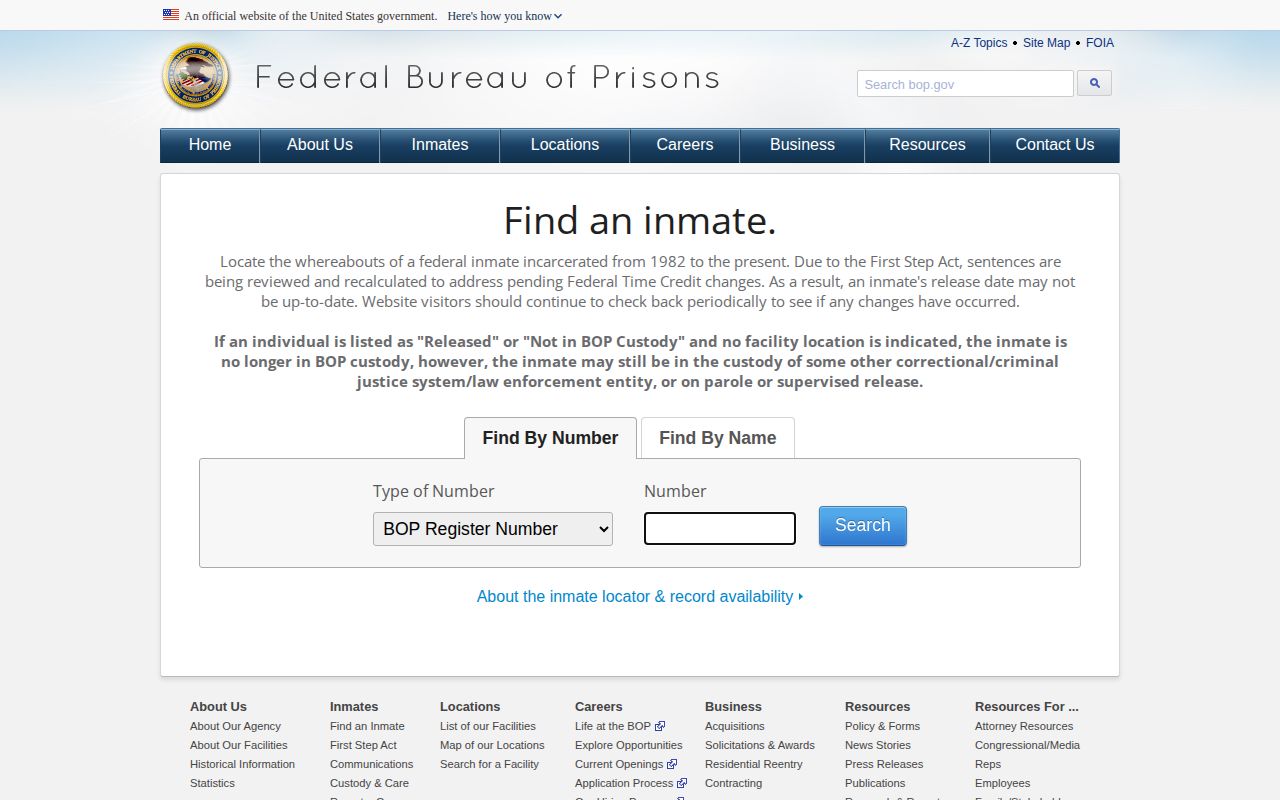
The screen is useful only after the custody path shows that BOP coverage applies. It should not replace the federal docket or USMS verification for a Portage pretrial hold.
ICE After Portage Release
ICE uses a separate Online Detainee Locator System. It accepts a nine-digit A-number or exact name with birth date and country of origin. ICE says the locator covers current detainees and people released from ICE custody within a recent limited window, subject to omissions and lag. A no-result cannot distinguish release, transfer, removal, noncoverage, or an identifier problem.
An ICE detainer asks a local facility to provide notice and hold a person for a limited period so federal immigration authorities can assume custody. A county release entry can therefore mark transfer to ICE rather than a community release. The research found no dedicated ICE detention facility or verified county ICE contract in Portage County. Do not imply one exists. If ICE custody is plausible, contact the relevant Enforcement and Removal Operations office or the ICE detention information line.
- Detainer
- A request tied to possible custody transfer; it is not itself proof of community release.
- Remand
- A court order keeping a person in custody.
- Supervised release
- Federal court supervision after confinement, distinct from BOP custody.
- Register number
- The federal identifier used for a precise BOP search.
Note: An ICE no-result is not proof that a person left all federal custody.
Portage Federal Movement Records
PCSO Records can document the Portage portion of the event. Ask for the booking or commitment entry, release date and time, release authority, receiving officer and agency, transfer destination, and code legend for any abbreviated field. Ohio's jail rule requires receiving officer and agency, time and date, and authority when release is to another agency. Those fields reveal whether the county handed the person to the Marshal.
The PCSO Records Division lists email, fax, mail, and phone channels. A narrow request should include the person's full name, approximate local custody dates, and federal case or register number when known. Ask for electronic copies and for exempt material to be redacted rather than using a request so broad that the event is hard to locate.
The official county sheriff page confirms the Justice Center contact, while the Portage court portal applies only when a related county case also needs review. The federal docket remains controlling for the federal order.
Portage County Justice Center
8240 Infirmary RoadRavenna, OH 44266
Non-emergency: 330-296-5100 option 9
Records: 330-297-3892
Administrative hours: Monday-Friday, 8 a.m.-4 p.m.
Resolve Portage Federal Status
Conflicting labels often describe different events. A judge can order release, PCSO can process a movement later, USMS can transport the person, and BOP can update after designation. Record the custodian, timestamp, and event wording for each source. The newest label is not always the answer if it belongs to a different system.
Identity matching needs stable points. Use name with date of birth, federal case number, register number, charge, and custody dates. Do not rely on name alone. A BOP RELEASED result proves the end of BOP custody under BOP's definition, but the federal docket is needed for court conditions and ICE must be checked separately where relevant.
The Portage County released-inmate search paths explain how a county hold differs from state prison and federal custody. For a federal contract prisoner, keep the investigation with the federal custodian after the local movement entry identifies the handoff.
Portage Federal Lookup Troubleshooting
A BOP no-result does not prove community release. The person may be a pretrial USMS detainee, may not yet be designated, may have an incorrect name or number, or may be outside the locator's time coverage. Return to PACER and the Marshal custody path. If BOP shows RELEASED, preserve the date and then check the federal docket for supervision or another court order.
An ICE no-result requires a different review. Check the exact nine-digit A-number or the required name, birth, and country fields. ICE data can lag or omit records, and children are not displayed. Contact the appropriate ICE information channel when the recent-custody question cannot be resolved. Do not use BOP status to infer an ICE result or use ICE absence to infer BOP release.
For PCSO, narrow the local request to the time spent at the Justice Center. Ask for the movement entry, receiving federal officer or agency, and the authority for release to that agency. If PCSO says no record exists, confirm that the person was actually held in Portage rather than another contract jail. A federal docket location does not by itself name the physical holding site.
Older federal sentences may fall outside BOP's 1982-to-present locator coverage and can require National Archives research. Modern projected dates may change because of sentence recalculation. UNKNOWN means the term is undetermined in the locator, not that release occurred. Each system's scope must stay attached to its result.
Federal custody follows the custodian. County, USMS, BOP, federal court, and ICE records answer different parts of the chain. A sound conclusion states which agency ended custody, what happened next, and which record supplies the legal basis.